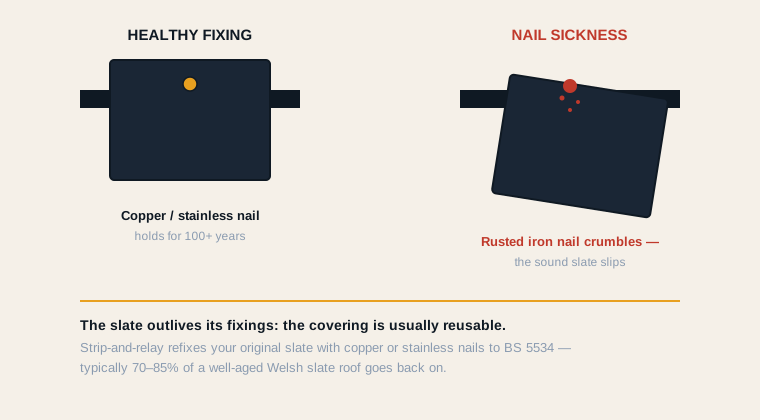
The covering decision matters more on this coast than almost anywhere inland, because the salt wind and driven rain punish a cheap choice. Natural Welsh slate is the traditional covering across Llandudno's Victorian and Edwardian stock, and for good reason: correctly fixed with copper or stainless nails to BS 5534, a slate roof gives a century of service and suits the conservation character of areas like Craig-y-Don and the West Shore. It costs more up front, but on a period property it is almost always the right long-term spend.
Concrete interlocking tile is the workhorse of the post-war estates around Penrhyn Bay and the newer stock, and for a 1960s or later semi it is entirely appropriate — faster to lay, more economical, and perfectly durable when the fixings and underlay beneath it are renewed. Clay plain tile sits between the two, offering a traditional look with excellent longevity. What we will not do is put a covering on that is wrong for the house: a lightweight tile on a roof built for slate, or a covering that clashes with a conservation streetscape, stores up problems and regret.
Whatever the covering, the parts you cannot see decide how long the roof lasts. New breathable underlay, treated battens at the correct gauge, mechanically-fixed ridges on exposed elevations, and properly-coded lead at every chimney and valley are what separate a re-roof that lasts fifty years from one that starts leaking in ten. We specify all of it in writing before a slate is lifted, so you know exactly what you are paying for and why.