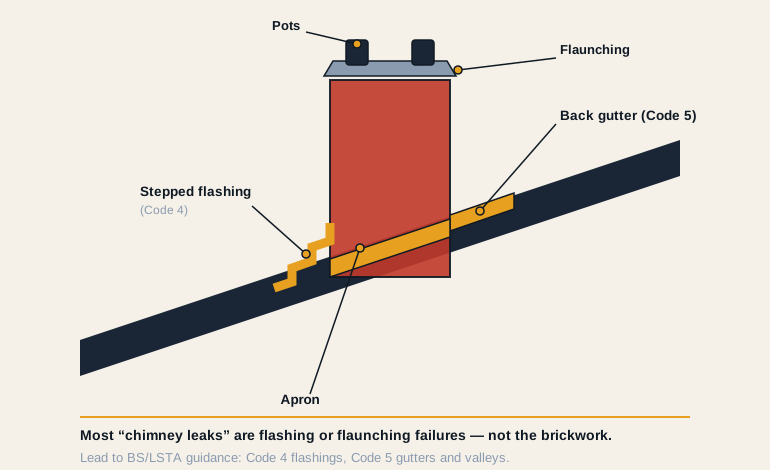
When water appears on a chimney breast, the instinct is to blame the stack itself — but in the large majority of the Llandudno chimney leaks we are called to, the brickwork is sound and the water is getting in at the details. The flashing where the stack meets the roof is the usual culprit: lead that has lifted, split from thermal movement, or was under-coded and simply too thin to survive this coast's wind. The flaunching — the mortar fillet that beds the pots — is the next most common failure, cracking and letting water track down inside the stack.
This matters because the fix, and the cost, are completely different. Re-flashing a stack with correctly-coded Code 4 or 5 lead, or re-flaunching around the pots, is a day's work and a few hundred pounds. Rebuilding a stack because someone assumed the brickwork was the problem is a far bigger and more expensive job. So we diagnose properly first: we get up to the stack, establish where the water is actually entering, and quote for what the roof needs rather than for the most expensive possible interpretation.
Where the brickwork genuinely has failed — spalling faces, eroded mortar joints, movement near the top — then repointing or a partial rebuild above the roofline is the honest answer, and on an exposed Llandudno stack we use a weather-appropriate mix and correctly-coded lead so the repair lasts rather than becoming an annual visit. Either way, chimney work needs scaffold to the stack for safe standing time; ladders are not safe for pointing or leadwork at ridge height, and we will not cut that corner.